Wealth Tracker:
one app for a dozen entities
I filed a tax extension in April and was still behind in late June: a dozen K-1s, a stack of entities, all of it in a pile. So I cancelled the app I was about to buy and built my own in an afternoon.
One app that replaced 5 subscriptions. My data, my categories, my rules. Here is what it does and why I think this is where a lot of software is heading.
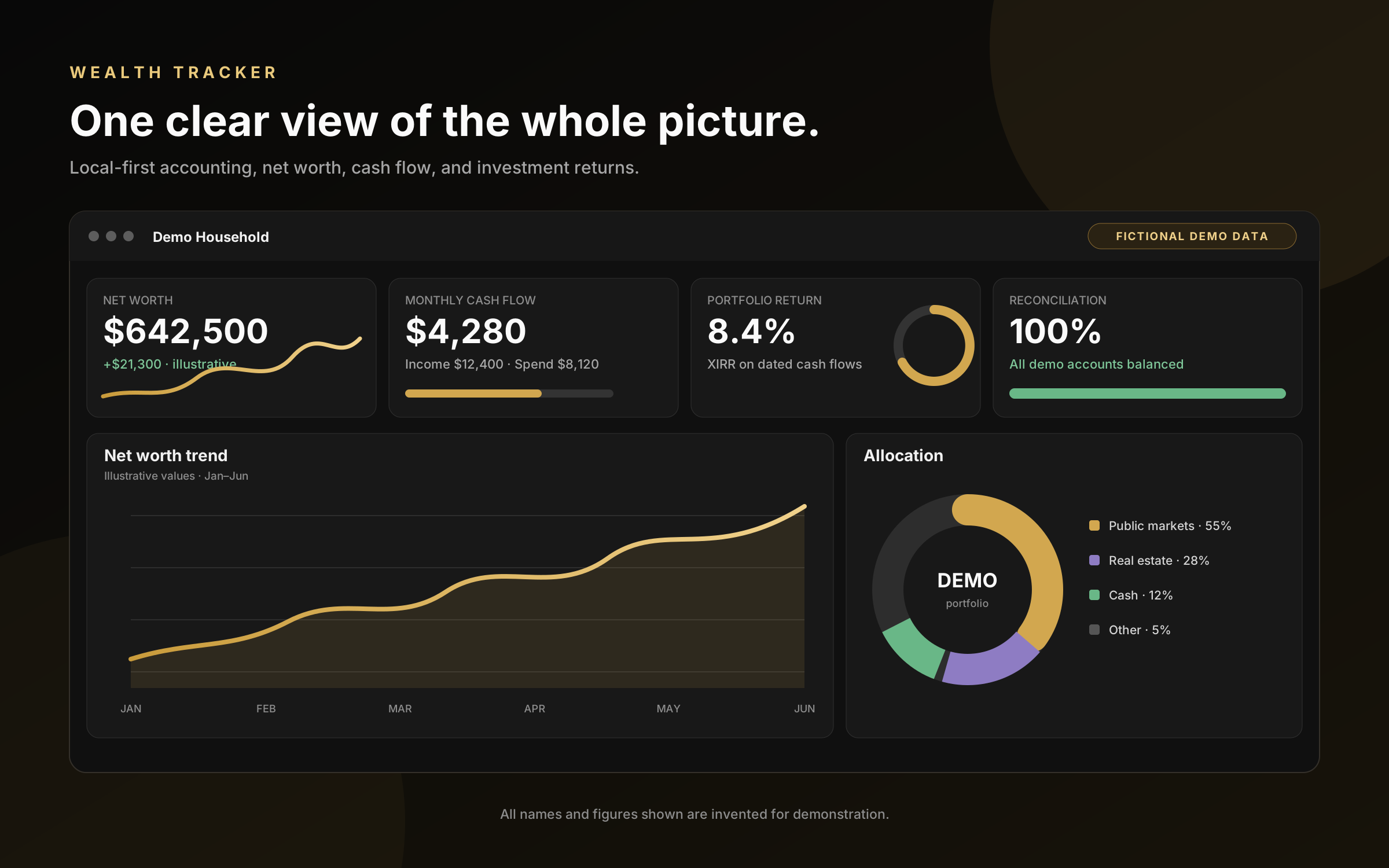
What's Actually Inside
One app. Every entity. My rules.
The first version took an afternoon. Then it earned its keep and I kept building. When my CPA asks where a number came from, I can trace it to the transaction, instead of shrugging at a dashboard someone else designed. And I still have zero Python skills. I wrote this the way I write everything now: in English, talking to the model until the screen matched the picture in my head.
Cash flow, drillable
Spending breakdowns that drill from group to category to the actual transactions, trailing-window trend charts, and a Sankey of where every dollar moved. Bulk categorize and confirm in one pass.
An owner's P&L per entity
Every entity gets a real statement: Income, Operating Expenses, NOI, Capital, Net Income. The rental, the operating business, the syndications, each on its own books, all in one view.
Net worth with a memory
Allocation, trend, and a holdings register built on snapshots the database itself refuses to rewrite. It even reconstructs syndication cash flows by parsing the raw wire descriptions from the bank feed.
Returns that hold up
True XIRR on dated cash flows (Newton's method with a bisection fallback), cash-on-cash, and MOIC, per investment. Capital calls, distributions, and return of capital tracked properly.
A retirement engine
Monte Carlo with 1,000 trials, block-bootstrapped from real 1928 to 2025 market history, reporting p10, p50, and p90 outcomes across side-by-side scenarios. In nominal or today's dollars.
Books my CPA can close
A per-entity close checklist, transfer matching, trial balance, and a one-click CPA package: a 10-sheet Excel workbook from P&L to general ledger to fixed assets, plus Schedule E detail.
Under The Hood
Private by architecture, not by policy.
My entire financial life lives in this app, so it is built like it. Nothing about my money sits on someone else's servers.
~900
categorization rules, longest match wins
1,000
Monte Carlo trials per forecast
10
sheets in the CPA export workbook
0
cloud services required to run it
Python FastAPI and a plain SQLite database on a Mac Mini in my office, with a React front end. No SaaS, no vendor, no per-seat fee.
Reachable only over my private Tailscale network. There is no public endpoint to attack.
Transactions and balances flow in from a scheduled Tiller feed; the app owns categorization and entity mapping, and my confirmations survive every resync.
Every night it snapshots the database, encrypts it, and ships it to cloud storage. The cloud only ever sees ciphertext, and the restore path is tested, not assumed.
Net worth snapshots are immutable at the database level. A trigger, not a promise.
Optional login with MFA and owner, CPA, and viewer roles, so my accountant gets a clean portal instead of a shared spreadsheet.
The Shift
From renting to owning.
For 20 years the answer to any problem was “there's an app for that,” and you rented it. That made sense. Building software took a team and a year, so you paid a monthly fee to use someone else's compromise.
It's starting to become “I'll build the app for that,” and you own it. Custom software was always possible if you had engineers. What changed is the cost of building the narrow, weird, exactly-shaped-for-you version just collapsed.
The honest catch
The moment you build it, you own it. The maintenance, the accuracy, the audit trail when your CPA asks where a number came from. That cost didn't disappear when I cancelled 5 subscriptions. It moved from a monthly fee to my own time and discipline.
So I'd think hard before telling anyone to do this. It's right for people with the time and temperament to keep their own system honest. If that's not you, keep your subscriptions. There's no shame in renting.
Get the code on GitHub.
The app is published under an MIT license with a one-commit clean history and independently invented demo data. Five minutes after cloning, you can explore every screen without connecting a real account.
- Runs entirely on your own hardware, tailnet-only
- Independently invented demo data + 309 backend tests
- Automated privacy, history, and secret scanning
Go Deeper
Rent or build?
I wrote up the full build and the trade-off I keep chewing on: in a few years, do most people still rent their software, or build it?